Corporate Governance
Contribution to SDGs objectives

The Group has identified three materialities related to governance: "corporate governance," "compliance," and "fair business environment." The Group is committed to upgrading its corporate governance system and, through ongoing dialogue with its stakeholders, is committed to honest corporate governance trusted by society.
Our approach to corporate governance
The Group strives to improve shareholder value stably in the long term, recognizing that strengthening corporate governance is essential for the continuous improvement of corporate value.
Respecting all the shareholders, the Group strives to achieve shareholder value stably in the long term and enhance its soundness and transparency. To this end, the Group will strengthen corporate governance by establishing a swift and rational decision-making system and an internal system that enables efficient execution of operations.
Structure
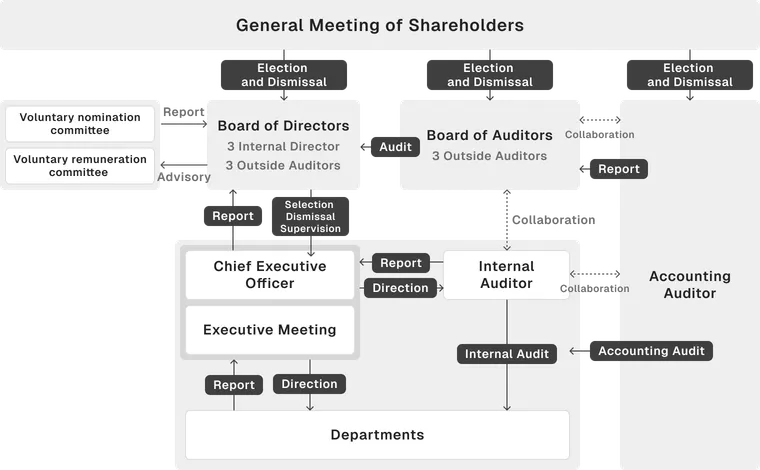
Board of directors
The Company's Board of Directors consists of six members (five male and one female), including three independent outside directors with extensive work experience and deep insight.
In addition to the regular monthly Board of Directors meetings, extraordinary meetings are held as necessary.
The Board of Directors will continue to make important management decisions and supervise the execution of operations by each director.
Board effectiveness assessments
The Company conducts analysis and evaluation of its board of directors' effectiveness to strengthen the board's functions further. The results of the assessment of the effectiveness of the Company's Board of Directors for the fiscal year ended December 31, 2025, showed that the composition and operation of the Board, director compensation and nominations, and training for the Board were generally appropriate and that the Company's Board of Directors had a solid commitment to the Company's business operations. The Company confirmed that the effectiveness of the Board of Directors is sufficiently ensured. Based on the results of the questionnaire-based evaluation of the effectiveness of the Board of Directors, the Chairman of the Board of Directors and the Secretariat of the Board of Directors will further enhance the effectiveness of the Board of Directors by focusing their efforts on the following points.
- Review and enhancement of the Board of Directors’ composition
- Further enhancing the focus and effectiveness of Board agendas and discussions
Board of auditors
The Board of Corporate Auditors holds a regular meeting once a month and extraordinary meetings as necessary to share information among the Corporate Auditors, including the formulation of audit plans and the status of audit implementation.
In addition to attending the Board of Directors and other important meetings, the Corporate Auditors also inspect important documents, ask questions of officers and employees, and perform further audit procedures by the audit plan to ensure proper monitoring of management. They also work closely with the Internal Audit Office and accounting auditors to improve the effectiveness and efficiency of audits.
Nominating and compensation committee
The Company has established the Nominating Committee and the Compensation Committee as voluntary advisory bodies to the Board of Directors regarding nomination and compensation to strengthen the fairness, transparency, and objectivity of procedures related to directors' nomination and compensation and enhance corporate governance further. The Board of Directors decides the nomination and remuneration of directors based on the reports of each committee.
Director appointment policies and procedures
-
Basic Policy
As a listed company, the Company places strong emphasis on the Board of Directors' independent oversight of senior management, including Executive Officers, and on maintaining transparent, accountable policies for executive appointment and dismissal.
Building on this approach, the Company has established common standards for all officers, while defining role-specific qualifications for Directors, Auditors, and Executive Officers. As business needs evolve, the Board periodically reviews the skills and capabilities required, along with its overall composition and nomination policies, aligned with Group strategy and risk profile.
In addition, the Company believes diverse perspectives and values are foundational to sustainable growth. In determining Board composition, the Company seeks an appropriate balance of knowledge, experience, and expertise, while actively promoting diversity across gender, nationality, professional background, and age. Candidate selection draws from a broad pool, with diversity embedded throughout the nomination process. -
Appointment procedures
The Company has established a Nomination Committee, composed solely of Outside Directors, as a voluntary advisory body to the Board of Directors in order to strengthen the fairness, transparency, and objectivity of the process for selecting Director candidates and to further enhance corporate governance.
In selecting Director candidates, the Nomination Committee conducts deliberations based on the Company’s approach to Board composition and the executive selection criteria established by the Company.The Board of Directors makes the final determination on Director appointments, taking into account the Committee's recommendations.
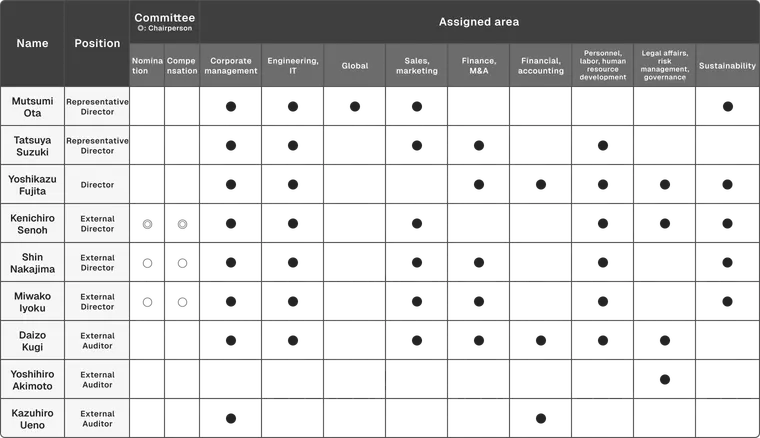
Skill Matrix
Policies and procedures for determining director compensation
-
Basic policy
The Company’s policy for the remuneration of Directors (excluding Outside Directors; the same applies throughout this section) is to maintain a compensation structure that provides effective incentives for the sustainable enhancement of corporate value. Specifically, the Company reviews compensation systems and compensation levels at companies of comparable size and business profile, while also assessing the appropriateness of its existing framework and compensation levels, in order to determine remuneration at appropriate levels based on each Director’s responsibilities and performance.
Director compensation consists of base compensation (monetary compensation), performance-linked compensation (monetary compensation), and stock compensation (restricted stock compensation).
Base compensation (monetary compensation) is determined according to each Director’s role and responsibilities and is paid in fixed monthly amounts.
Performance-linked compensation (monetary compensation) is designed as an incentive for enhancing corporate value, with payment amounts determined based on the achievement level of the EBITDA plan for the applicable fiscal year.
Stock compensation (restricted stock compensation) is granted to Directors as an incentive for enhancing medium- to long-term corporate value through alignment with shareholder interests and greater awareness of share price performance. Such compensation is granted annually within the maximum amount approved by shareholders at the General Meeting of Shareholders. The number of shares granted is determined with reference to compensation practices at companies of comparable size and business profile.
Outside Directors receive only base compensation (monetary compensation) in light of their supervisory role. -
Procedure for determining compensation
The Company has established a Compensation Committee, composed solely of Outside Directors, as a voluntary advisory body to the Board of Directors in order to strengthen the fairness, transparency, and objectivity of procedures related to Director compensation and to further enhance corporate governance.
With respect to individual Director compensation, the Compensation Committee deliberates on the compensation structure and compensation levels, among other matters, and the Board of Directors determines the final compensation amounts based on the Committee’s recommendations.
Anti-corruption policy
The Group considers the recent increase in global awareness of bribery an essential factor in achieving sustainable growth of its domestic and overseas business.
To avoid the following corrupt practices, the Company Group will consider, establish, and continuously improve appropriate anti-corruption management systems following the characteristics and risks of each country or region.
- Giving Bribery
- Facilitation payments
- Accepting Bribery
- Illegal entertainment and gifts
- Insider trading
We shall also establish and maintain the following appropriate systems based on the policy.
- Records and Retention
All officers and employees shall comply with procedures for financial reporting, accurately record all transactions in the accounting books, and properly store related documents.
- Audit
The Company shall appropriately operate a system of self-inspections and internal audits of compliance with internal rules established based on the Company's anti-corruption policy by the degree of risk.
- Establishment of a hotline for reporting corruption
To ensure compliance with the Group's Anti-corruption Policy, the Company has established a hotline where officers and employees can report general compliance issues, including anti-corruption matters. To protect the privacy of the individual, anonymous reporting and consultation are permitted.
The hotline is assigned a person responsible for managing and supervising the operation of the contact. The person in charge works on problem-solving measures and recurrence prevention measures. Suppose the content of the report or consultation is deemed necessary. In that case, the content of the report or consultation is promptly reported to the Board of Directors while ensuring the anonymity of the person making the report or consultation, and the Company takes action.
The Group will also request cooperation from its business partners to prevent corruption.
Internal training on ethical standards
The Group stipulates compliance with laws, regulations, internal rules, and corporate ethics in its Compliance Regulations. It conducts periodic training sessions for all officers and employees on the relevant laws and regulations to ensure thorough compliance.
Risk management
The Company has established "Risk Management Regulations" and a company-wide management system to appropriately manage various risks that may hinder the Company's efforts to maintain sound management, drive its business forward, and enhance its corporate value.
In addition, to appropriately and promptly respond to risks that could have a significant impact on management, the company has established a Risk Management Committee chaired by the CFO, responsible for the Corporate Division to recognize and identify risks that must be addressed in the course of business activities, including sustainability-related risks, and to discuss countermeasures.
The Risk Management Committee plays a central role in analyzing and understanding the significant risks identified and integrating them into company-wide risks to reduce and prevent them.